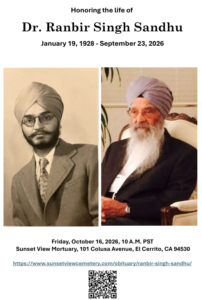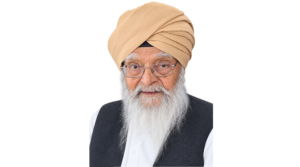
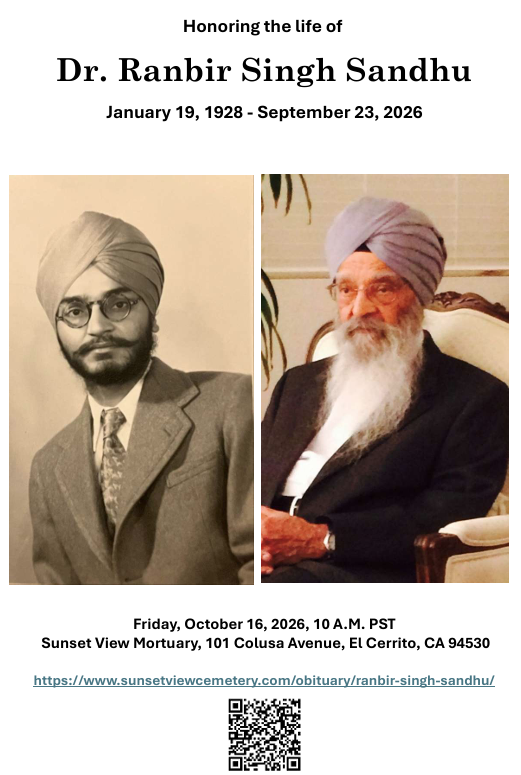
Professor Dr. Ranbir Singh Sandhu
Scholar, Teacher, Husband, Father, and Servant of Humanity
January 20, 1929-September 23, 2026
Professor Ranbir Singh Sandhu was born in Lyallpur, Punjab, the seventh of eight children of Sardar Pratab Singh Sandhu and Sardarni Harnam Kaur Sandhu (Bajwa). A gifted child with a photographic memory, he mastered Punjabi, Urdu, Sanskrit, and six other languages.
At fourteen, he was accepted into engineering college and joined India’s freedom movement. During Partition, he sought protection for classmates in Lahore, was beaten and left for dead, and a granthi later noticed him moving among bodies on a cart and saved his life. Despite displacement, illness, and hardship, he graduated in 1949, first in his engineering class and the state’s highest-scoring graduate.
He began his career in irrigation, helping design and build Bhakra Dam. His ingenuity and curiosity made him a trusted problem-solver. After his father’s death, he offered to sacrifice his career to care for his mother, sister, and critically ill brother. However, senior colleagues prevented him from doing so, recognizing the impact he could have on the projects envisioned for the nascent nation.
In 1957, he married Surinder Kaur Sarkaria, his best friend and lifelong love. “She civilized me and re-introduced me to my faith,” he said, and when asked what made their marriage so successful, he answered, “I love her.”
A Commonwealth Scholarship took him and his growing family to Sheffield, England, for his master’s degree. He earned his PhD at the University of California, Berkeley, in 1968, then joined Harza Engineering in Chicago, specializing in dams and the finite element method. Research and teaching remained his calling, and in 1969 he joined The Ohio State University, where he taught until 1995 and earned recognition for his research and distinguished teaching. Former student Tom Irvine created an endowment in his honor.
Dr. Sandhu treated his students as his own children. He brought advanced concepts into undergraduate classrooms, opened doors to research and graduate study, championed women in engineering, and helped establish mentoring for minority students.
His family joked that he spoke in forty-eight-minute increments—the length of an Ohio State class. Even rides to school became lessons in mathematics, science, and whatever had captured his imagination. Faith informed his compassion, social conscience, and hospitality. He and his wife welcomed students, immigrants, travelers, relatives, and friends into their home, offering refuge, guidance, and encouragement. He welcomed everyone.
A respected Sikh scholar and community leader, he helped establish congregations and gurdwaras in the San Francisco Bay Area and Chicago. He and his wife studied Sikh history and scripture together. His language skills helped him translate them for audiences nationwide.
He cofounded Sikh educational and interfaith organizations and served as founding Secretary General of the World Sikh Council–America Region. He advocated for legal recognition of Sikh marriage in Ohio and for Sikhs’ right to maintain their articles of faith in military service. His scholarship included Struggle for Justice, a thoroughly researched study of Sikh persecution in India.
Beyond his accomplishments, he was warm, funny, and endlessly engaging. He made literature, history, science, and politics fascinating, delighted children with stories and experiments, and always saw the good in people. He was unimpressed by wealth and status; character mattered most to him. Professor Sandhu lived an extraordinary life on his own terms. He adored his wife and family, embraced humanity as his own, and lived his faith. His legacy of intellect, courage, compassion, and love endures. He is deeply missed.