
EXPLORING FAITH
AND RELIGION
SPIRITUALLY ACROSS
CULTURES
Unity in diversity through interfaith dialogue and understanding.
SIKH COUNCIL FOR INTERFAITH RELATIONS WEBSITE IS
(UNDER CONSTRUCTION)
Lorem ipsum dolor sit amet, consectetur adipiscing elit. Ut elit tellus, luctus nec ullamcorper mattis, pulvinar dapibus leo.
The Gurdwara
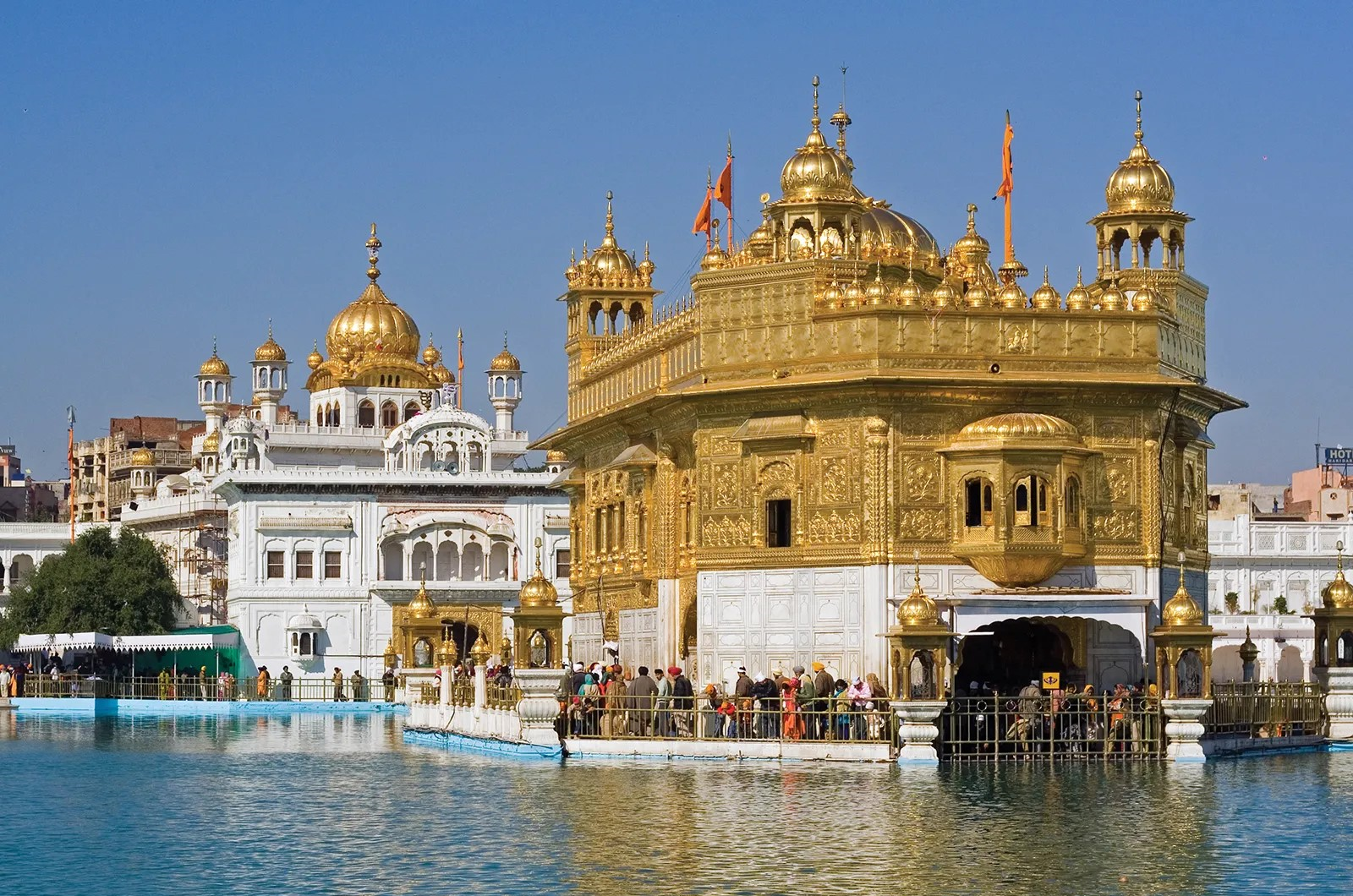
The Gurdwara
A Sikh place of prayer and worship is called a Gurdwara. Gurdwara is often translated as either the Guru (or God)’s Doorway (“Dur”), or God’s Court (“Darbaar”). These are not as different as they sound because both the door and the court where the congregation gathers both help lead us to know and understand God‘s Message.
All people of any religion or origin are always welcome in a Gurdwara because Sikhs believe that God belongs to and equally loves all people. The four doors — one in each direction (North, South, East and West) — at Harmandar Sahib symbolize this spirit. In fact, many Gurdwaras are designed this way (with entry doors in all four directions). There are no statutes, altars, likenesses of God or Gurus, or bells to ring. Gurdwaras are not temples or churches, but they are places of worship: places to pray, to study, to discuss and clarify understanding, and a place to get support physically, mentally, and spiritually.
Although all people of all religions are welcome in a Gurdwara, there are a few basic requirements for everyone who enters. All people must be dressed modestly, they remove their shoes, often wash their feet and hands, and cover their heads before entering. Since both the Sangat (the congregation in the Darbar Hall), and the Pangat (the rows in the langar) are usually seated on the floor, most people wear some form of baggy pants, or the Kachera for discretion and comfort.
In the Darbar Hall (court) of all Gurdwaras set upon a Takht (throne), often inside a Palki (pronounced: paal – key) or Palanquin, wrapped in silk and satin cloths called ‘rumalas’ (pronounced: room-ala(s)) is a copy of The Living Word or Message of God, or Bani in the complete version that we refer to as Siri Guru Granth Sahib. Sikhs believe Siri Granth Sahib to be their Eternal Guru and Spiritual guide.
The decorum surrounding Guru Granth Sahib is parallel to the way that most mighty Emperors of the world have carried themselves and their Courts. When Sikhs enter this room, they go up and make their voluntary offering (the Sikh faith also expects the sharing of one-tenth of the Sikh’s income) and then bow to the floor to indicate their obeisance to God and His Message.
Sikhs have no priests! Any Sikh in his or her proper clothing and appearance and able to read the prayers may read from Guru Granth Sahib Ji at any time. Any Sikh (with head covered, clean hands and bare feet) may offer a Sabad and lead the Sangat in the singing of a prayer.
Some people who are valued and respected for their knowledge and have the time are sometimes asked to stay in the Gurdwara. They are called Sevadar(s). They are caretakers for their Gurdwara. Although they can be of either gender, or a family, they are mostly men. These chosen people are responsible for protecting the Gurdwara and ensuring that all functions of the Gurdwara are running as they are expected to. They often coordinate the schedule for leading the daily prayers, special events, Langar Seva, Weddings, and maintenance.
The authority in the local Sangat (the group of God’s people who gather in the Gurdwara to sing God’s prayers and remember His Word) is vested in the Khalsa who are represented by the Punj Piyarey or Five Beloved Ones. The Punj Piyarey are any 5 Sikhs who have been initiated into the religion by taking Khande-di-Pahul. They are respected for their understanding of the Scripture and the way they practice their faith in their lives. All people who come to pray sit together on the floor facing Siri Guru Granth Sahib with their legs crossed, and their palms together.
Inside each Gurdwara, there is a place for a traveler to stay, there is a safe and protected place for anyone in danger (a sanctuary), and there is a community kitchen called the Langar (pronounced: Lung-er). Only vegetarian meals are prepared and served in the Langar. This is so that
- The food is acceptable to all people regardless of the restrictions of their religions (i.e. Some religions restrict eating beef, pork, shellfish, or all and any meat).
- The food served is supposed to be simple, humble and wholesome food, and not fancy or exotic.
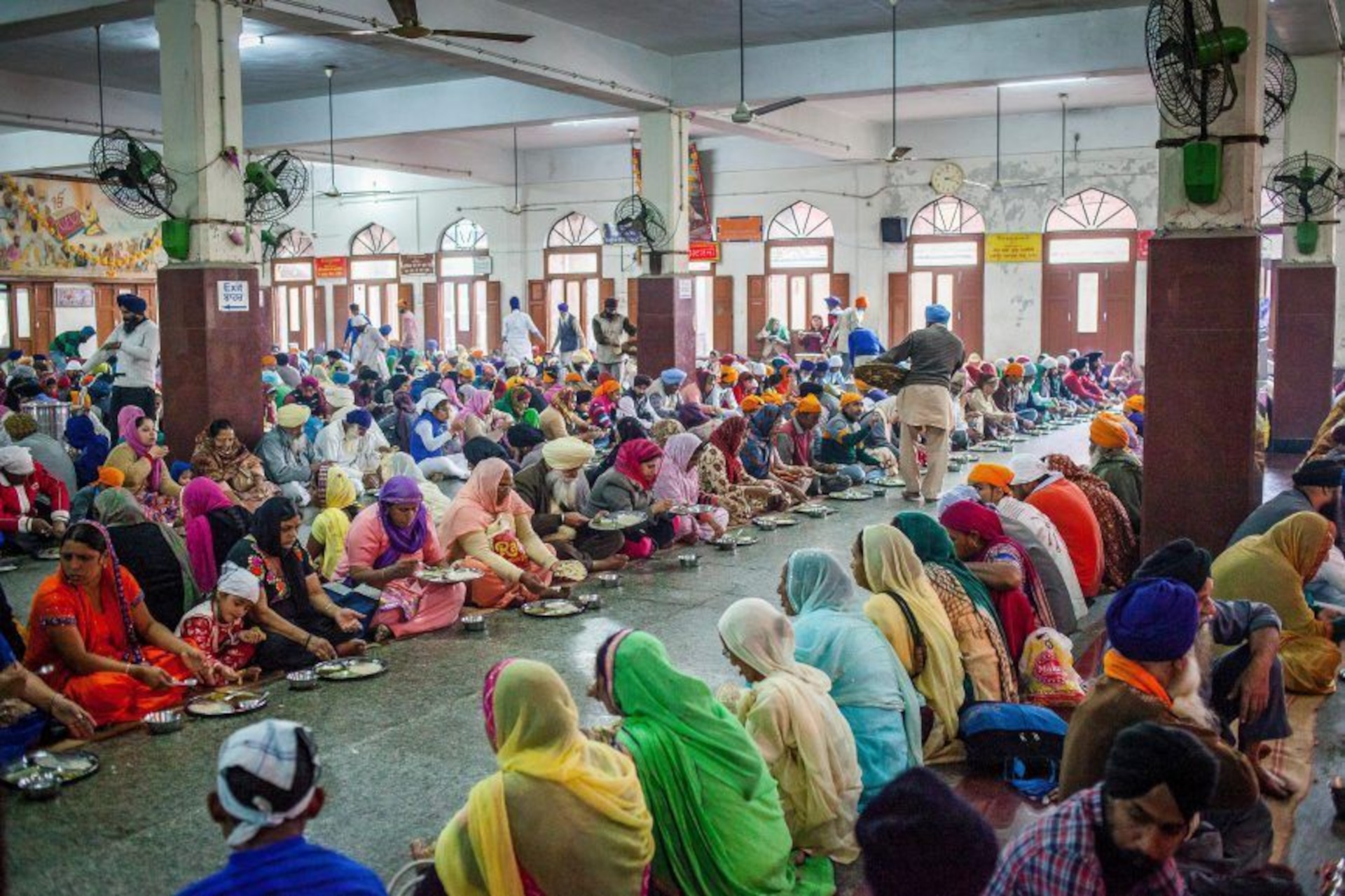
Anyone from any religion, any race, nationality, class or caste can come for food in the Langar. One other important aspect of the langar is that all the people who come to eat must sit equally, ideally, on mats on the floor — whether they are rich, famous, and important or they are poor and unknown. The rows in which Sikhs sit when having Langar are called the Pangat.
The Langar
The Langar
Although the word “Langar” in Punjabi language means a kitchen or the place where the needy can get food,[1] in Siri Guru Granth Sahib,[2] Langar refers to the passing on the Divine Message to the assembly of devotees through the Guru’s word as well as to the distribution of food to them.[3]
Many religious and philanthropic organizations have arrangements to feed the poor and the needy. This is commendable, but it implies that some people are low and needy and there are some people who are high, but nice and they help feed them. In the Sikh religion, equality of all people is stressed. So, the Langar institution represents “sharing” and not “charity.”
The practice of serving food to visiting devotees started with the first Guru, Siri Guru Nanak Sahib. Beside the people living with or in service of the Guru, many visitors would come to see him from far away places. Guru Nanak Sahib and the succeeding Gurus made arrangements for providing these visitors food, shelter, and other supplies they needed during their visit.
Regardless of who provided the funds for the food, it is called “Guru Ka Langar” and not of any person or persons. All contributions are offered to Siri Guru Granth Sahib and it is through the Guru’s grace that everyone receives the food.
It is said that, during the reign of the fifth Guru, Siri Guru Arjan Sahib, a group of devotees coming from Lahore, (now in Pakistan) decided to spend the night at Chheharta – a village about four miles from Amritsar and to visit Guru Sahib the next morning. Guru Sahib learned of this, so he got food prepared for the group and personally took it to them in Chheharta.
The Langar Hall is an integral part of the Gurdwara . When entering the Gurdwara, it is required that everyone remove their shoes and cover their heads. At the entrance to the Gurdwara, scarves are provided for covering the head. There are shoe racks or a check- in room for your shoes. All those who come to share the langar are treated as equal. To emphasize this, everyone sitting in rows has the same type of seating and sits at one level. This is called the “Pangat.” Langar Volunteers walk in the aisles serving food and water. When people are done eating, there are more volunteers who take your dirty dishes and then clean them out for the next diners.
Continuing the practice introduced by the Gurus, every gurdwara (Sikh place of worship) provides food and often shelter to all visitors regardless of their religious belief, race, gender, social status, or any other distinction.
Langar is served after every congregational event held in the presence of Siri Guru Granth Sahib. In large gurdwaras which have visitors coming and going at all hours, food is served all day – sometimes round the clock. The Langar at Siri Darbar Sahib in Amritsar serves nearly a hundred thousand meals every day. At many gurdwaras, regular service with large attendance is typically limited to weekends. However, even stray visitors dropping by at any time can be assured at least of a simple meal.
A wholesome vegetarian meal that is all people can eat is served in the Langar. While the food is prepared by volunteers in the kitchen, prayers from Siri Guru Granth Sahib are recited.
The Langar Hall is part of the Gurdwara complex. When entering the complex, it is required that everyone take off shoes and cover their heads. At the entrance to the Gurdwara Complex, scarves are provided for covering the head and there are shoe racks or a check- in room for your shoes. All those who come to share the langar are treated as equal. To emphasize this, everyone has the same type of seating. This is called the “Pangat”. Volunteers walk in the aisles serving food and water.
[1] Bhai Kahan Singh Nabha, Mahaan Kosh.
[2] Siri Guru Granth Sahib consists of teachings of the Gurus as well as selected compositions by several Hindu and Muslim holy men. Siri Guru Gobind Singh Sahib, the tenth and last Guru in human form declared Siri Guru Granth Sahib and the Guru Panth – comprising all formally initiated Sikhs – as the eternal Guru.
[3] Siri Guru Granth Sahib, page 967; 1430 page version, referring to the second Guru, Siri Guru Angad Dev Ji’s congregation.